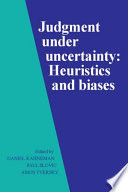
Heuristics are mental shortcuts that simplify decision-making processes. Daniel Kahneman, Amos Tversky, and other contributors to the book explore how these heuristics, while often leading to effective decisions, can also result in systematic biases. The authors identify several key heuristics, including representativeness, availability, and anchoring. For example, the representativeness heuristic leads individuals to judge the probability of an event based on how much it resembles their existing stereotypes or knowledge. This can lead to errors, such as overestimating the likelihood of rare events simply because they fit a familiar narrative. The availability heuristic, on the other hand, leads individuals to make judgments based on how easily examples come to mind. This can skew perceptions of risk, as people may overestimate dangers that are highly publicized. Anchoring refers to the tendency to rely too heavily on the first piece of information encountered when making decisions. These heuristics illustrate the cognitive shortcuts that our brains take, which can sometimes result in flawed judgments.
Continue readingThe book delves into various cognitive biases that arise from the heuristics mentioned earlier. Biases are systematic deviations from rationality in judgment. Some of the most notable biases discussed include confirmation bias, where individuals favor information that confirms their pre-existing beliefs, and hindsight bias, where people believe they could have predicted an event after it has occurred. These biases can significantly impact decision-making in personal, professional, and societal contexts. For instance, in business, confirmation bias can lead to poor investment decisions as investors may ignore data that contradicts their beliefs about a company’s potential. The authors emphasize that understanding these biases is crucial for improving decision-making and reducing errors, as they often lead individuals to make choices based on flawed reasoning rather than objective analysis.
Continue readingProspect Theory, developed by Kahneman and Tversky, provides a more accurate description of how people make decisions under risk compared to traditional utility theory. The theory posits that individuals evaluate potential losses and gains differently, leading to risk-averse behavior when faced with potential gains and risk-seeking behavior when faced with potential losses. This asymmetry is illustrated through the concept of loss aversion, which suggests that losses weigh more heavily on individuals than equivalent gains. For example, losing $100 feels more painful than the pleasure derived from winning $100. The implications of Prospect Theory are vast, influencing fields such as economics, finance, and behavioral science, as it challenges the notion that people always act rationally in pursuit of their best interests.
Continue readingThe book emphasizes the challenges of making decisions in uncertain environments. Traditional decision-making models often assume that individuals have access to complete information and can calculate probabilities accurately. However, Kahneman and Tversky argue that in reality, people often operate under conditions of uncertainty, where information is incomplete, and outcomes are unpredictable. This uncertainty can lead to overconfidence, where individuals believe they have more control over outcomes than they actually do. The authors propose that recognizing the limits of our knowledge and the inherent uncertainty in many situations can lead to better decision-making strategies. This includes adopting a more probabilistic approach to decision-making and being open to revising beliefs in light of new evidence.
Continue readingFraming effects refer to the way information is presented and how it can influence decision-making. The authors illustrate that the same choice can lead to different decisions depending on how it is framed. For instance, a medical treatment described as having a 90% success rate may be more appealing than one described as having a 10% failure rate, even though they represent the same information. This highlights the importance of context in decision-making and suggests that individuals are not only influenced by the actual content of information but also by its presentation. Understanding framing effects can help individuals and organizations craft better messages and make more informed decisions by recognizing the potential biases introduced by framing.
Continue readingThe authors also explore how group dynamics can affect decision-making processes. Group decision-making can lead to phenomena such as groupthink, where the desire for harmony and conformity results in poor decisions. This can occur when dissenting opinions are suppressed, leading to a lack of critical evaluation of alternatives. The book discusses strategies for improving group decision-making, such as encouraging open dialogue, soliciting diverse perspectives, and establishing a culture that values constructive criticism. By understanding the dynamics of group decision-making, organizations can foster environments that promote better outcomes and reduce the risks associated with collective bias.
Continue readingFinally, the book discusses the broader implications of the findings on judgment and decision-making for policy and practice. The insights gained from understanding heuristics, biases, and decision-making processes can inform public policy, business strategies, and personal choices. For example, policymakers can design interventions that account for human cognitive limitations, such as default options in retirement savings plans that encourage better financial decisions. Similarly, organizations can implement training programs that raise awareness of cognitive biases among employees, leading to improved decision-making practices. The authors argue that by applying the lessons learned from their research, individuals and organizations can enhance their decision-making capabilities and achieve better outcomes.
Continue readingThe reading time for Judgment Under Uncertainty depends on the reader's pace. However, this concise book summary covers the 7 key ideas from Judgment Under Uncertainty, allowing you to quickly understand the main concepts, insights, and practical applications in around 24 min.
Judgment Under Uncertainty is definitely worth reading. The book covers essential topics including Heuristics, Biases, Prospect Theory, providing practical insights and actionable advice. Whether you read the full book or our concise summary, Judgment Under Uncertainty delivers valuable knowledge that can help you improve your understanding and apply these concepts in your personal or professional life.
Judgment Under Uncertainty was written by Amos Tversky, Daniel Kahneman, Paul Slovic.
If you enjoyed Judgment Under Uncertainty by Amos Tversky, Daniel Kahneman, Paul Slovic and want to explore similar topics or deepen your understanding, we highly recommend these related book summaries:
These books cover related themes, complementary concepts, and will help you build upon the knowledge gained from Judgment Under Uncertainty. Each of these summaries provides concise insights that can further enhance your understanding and practical application of the ideas presented in Judgment Under Uncertainty.